Skip to content
Menu

These earn us a commission through Viator. Same price for you, and the commission had no hand in the order.

Search
Clipped hedges and a stone basin in a formal garden with palms rising behind
Unsplash

Historic site

Holocaust Memorial Miami Beach

Last updated

A memorial built by the survivors who settled on this island, designed as a single walk you are meant to take in order.

The address is 1933–1945 Meridian Avenue. The number is the span of the Nazi regime, and it was assigned on purpose. That is the first thing the memorial tells you, and it sets the terms for everything after it.

The reason it stands here rather than anywhere else is demographic. By the 1970s and 1980s, Miami Beach held one of the largest concentrations of Holocaust survivors in the United States — people who had come to the United States after the war, many of them older, many living in the small apartment buildings of South Beach. This memorial was their project. A committee of survivors, working through the Greater Miami Jewish Federation, raised the money and commissioned the architect Kenneth Treister. It was dedicated in 1990.

Treister designed a sequence rather than a monument. You enter from Meridian Avenue into a colonnade of Jerusalem stone, move through a domed rotunda, and then into a narrowing passage — the Lonely Path — whose walls carry the names of the camps and close in as you walk. The passage opens onto the central plaza and The Sculpture of Love and Anguish: a bronze forearm rising around forty feet from a reflecting pool, tattooed with an Auschwitz number, with human figures climbing it and gathered at its base. The last part of the walk is the Memorial Wall, carrying names, and a garden of stone and water that returns you to the street.

It is not a museum. There are no galleries, no film, no gift shop, no ticket. It is a walk that takes as long as it takes, and the design does the work of pacing you.

Visitors do arrive without knowing what they have come to. The memorial sits on a corner in the middle of ordinary Miami Beach, across Dade Boulevard from the convention centre and a short walk from a botanical garden and a pedestrian shopping street. Nothing on the outside prepares you. Go in knowing.

Getting there and parking

At the corner of Meridian Avenue and Dade Boulevard, on the north-western edge of the South Beach grid, across Dade Boulevard from the Miami Beach Convention Center.

On foot. About ten minutes north-west from the western end of Lincoln Road. About twenty-five minutes from Ocean Drive at 10th Street, which is a long walk in summer heat.

Trolley and bus. The free Miami Beach Trolley's South Beach loop covers Washington Avenue and the 17th Street area; the South Beach Local bus also serves the convention centre district. Both leave a short walk.

Parking. Use the 17th Street municipal garage or the convention centre garages and walk the last few minutes. Meridian Avenue is metered, partly residential, and enforced seriously.

Driving from the mainland. The MacArthur Causeway lands at 5th Street; Alton Road north to Dade Boulevard is the usual approach. The Venetian Causeway arrives closer, at Dade Boulevard itself, but is tolled and slow.

The sequence, and why it runs in one direction

Treister's design is processional. Each part prepares you for the next, and taken out of order the memorial loses most of what it is doing.

The arcade and the rotunda. You enter through a colonnade of Jerusalem stone. The rotunda that follows carries the first inscriptions and slows you down before anything difficult is asked of you.

The Lonely Path. A tunnel that narrows and darkens as it goes. The names of the camps are cut into the walls on either side, and the sound changes as the space tightens. Children's voices are carried on a recording. This is the hardest part of the walk and it is short.

The plaza and the sculpture. The passage opens without warning onto the reflecting pool and the bronze arm. Figures ascend it; other figures stand and lie in the plaza around it, at life size, on the same ground as you. That is the decision that makes this memorial different from a plinth-and-inscription one — there is no separation between the visitor and the sculpture.

The Memorial Wall and the garden. Names, then stone, water and planting, then the street. The return is deliberately gradual.

Follow it as laid out. Doubling back to photograph something is the behaviour the design is built to discourage.

Visiting with respect

This is a place of mourning and an active site of commemoration. Families of the dead come here. Survivors' descendants come here. Yom HaShoah is marked here.

  • Dress as you would for a place of worship. The memorial is four blocks from the beach and people do arrive in swimwear. Cover up before you go in.
  • Keep your voice down and your phone away. Photography is not forbidden, but posed photographs in front of the sculpture are not appropriate, and neither is filming yourself walking the Lonely Path.
  • Do not climb on or touch the bronze figures. They are at ground level precisely so that you walk among them.
  • Bring children in prepared. Older children can take it; the memorial does not soften anything. Read the sequence above and decide honestly.
  • Leave time at the end. The garden at the exit exists for that.

Group visits with a guide can be arranged in advance through the memorial rather than turned up with. A printed guide for self-directed visits has long been available at the entrance.

There is no admission charge and never has been. A donation box supports the memorial's upkeep and its education programme.

Practical details, honestly hedged

Where. The corner of Meridian Avenue and Dade Boulevard, on the north-west edge of the South Beach street grid. It is across Dade Boulevard from the Miami Beach Convention Center and a short walk from the Miami Beach Botanical Garden, which shares the same block of Convention Center Drive.

Hours. Published as daily, 9:30am until sunset, with free entry. Sunset in Miami Beach runs from about half past five in December to after eight in June, so the closing time moves by nearly three hours across the year. Confirm before travelling on a specific day; commemoration events occasionally alter access.

Getting here without a car. The free Miami Beach Trolley's South Beach loop runs along Washington Avenue and up towards 17th Street; from Lincoln Road's western end it is a walk of about ten minutes north-west. From Ocean Drive at 10th Street it is roughly twenty-five minutes on foot, or a short rideshare.

Parking. The 17th Street municipal garage and the convention centre garages are the nearest structured parking and the sane choice. Meridian Avenue itself is metered and residential in places, and enforcement on Miami Beach is brisk.

Accessibility. The route is paved and level throughout, and the Lonely Path is step-free. The tunnel is narrow, which is intentional and which some visitors find difficult; the plaza can be reached without passing through it if that is necessary.

Near Holocaust Memorial

Straight-line distances, so allow more on the road — the island is long and has one main parkway.

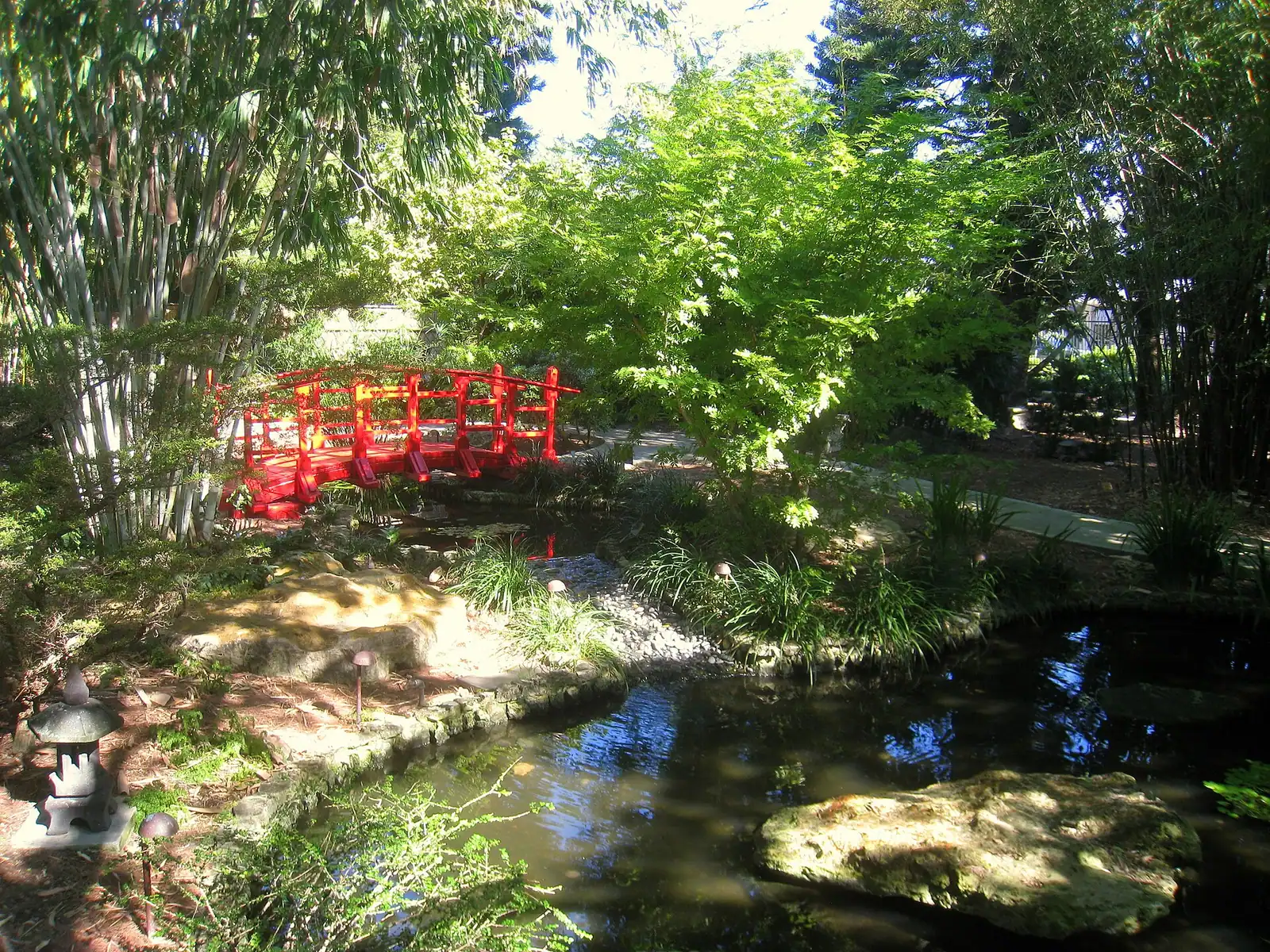
  • A red timber bridge crossing the pond in the Japanese garden at the Miami Beach Botanical Garden

    Park

    Miami Beach Botanical Garden

    Free

    Two and a half acres of free, densely planted shade behind the convention centre — the coolest ground in South Beach in August.

    0.5–1 hoursFree. Donations and memberships support the non-profit that runs it.0.3 mi away

  • A darkened auditorium with tilted seating and projected imagery filling the ceiling above

    Entertainment

    New World Center

    Frank Gehry's hall for an orchestral academy, with a 7,000-square-foot wall that plays the concert to the park for free.

    1–2.5 hoursTicketed for concerts inside, with many performances published starting at around $25. WALLCAST concerts projected onto the east wall and watched from SoundScape Park are free and need no ticket.0.4 mi away

  • Curving paved walkways through low planting in a landscaped urban park

    Park

    SoundScape Park

    Free

    Two and a half acres of Dutch-designed lawn and shade whose best feature is the building next door playing concerts onto its wall for free.

    0.5–2.5 hoursFree, including the WALLCAST concert simulcasts and outdoor film screenings.0.4 mi away

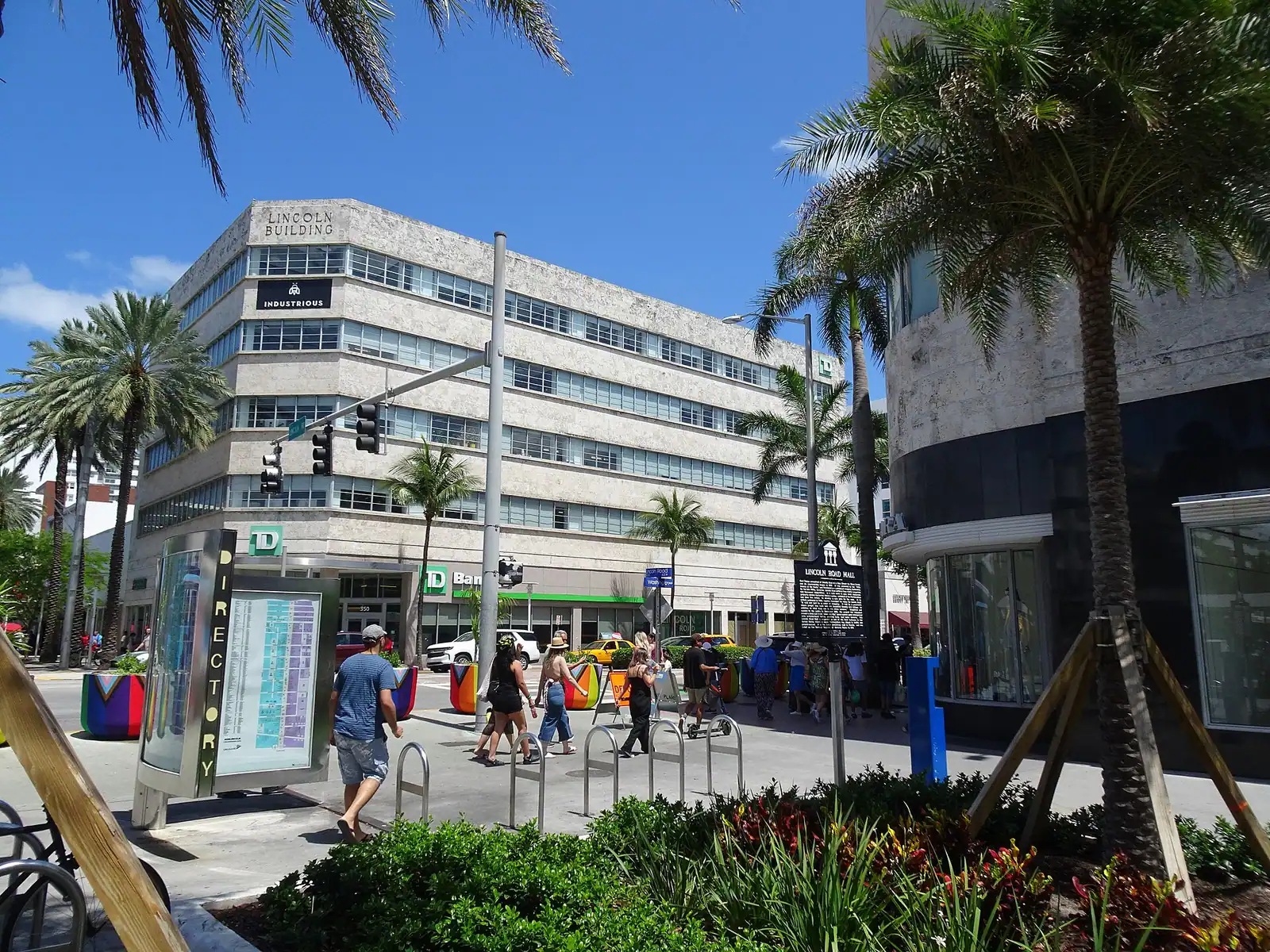
  • A wide pedestrian shopping street lined with palms and terraces under strong midday sun

    Shopping

    Lincoln Road Mall

    Free

    A Morris Lapidus landscape from 1960 that has become a chain high street, with three blocks at the western end that have not.

    1–3 hoursFree to walk. Shops, restaurants, cinema and theatre tickets are not.870 ft away

Holocaust Memorial: common questions

Is the Holocaust Memorial in Miami Beach free to visit?

Yes. There is no admission charge and there never has been. The memorial is published as open daily from 9:30am until sunset, and a donation box near the exit supports its upkeep and education programme. Guided visits for groups are arranged in advance with the memorial rather than booked on arrival. Confirm current opening information before travelling on a specific date.

Why is there a Holocaust memorial in Miami Beach?

Because the survivors were here. By the 1970s and 1980s Miami Beach held one of the largest concentrations of Holocaust survivors in the United States, many of them living in the small apartment buildings of South Beach. A committee of those survivors, working through the Greater Miami Jewish Federation, raised the funds and commissioned the architect Kenneth Treister. The memorial was dedicated in 1990. It is a local memorial, built by the people it commemorates.

What does the street address 1933-1945 mean?

It is the span of the Nazi regime, from 1933 to 1945, and it was assigned to the memorial deliberately. The building has no other reason to carry that number on Meridian Avenue. It is the first element of the design a visitor encounters, before entering the site at all.

Should you take children to the Holocaust Memorial Miami Beach?

That is a judgement for the adult bringing them, and the memorial does not soften anything. The Lonely Path narrows and darkens and carries the names of the camps and recorded children's voices; the central sculpture is explicit about suffering. Older children who have studied the period can take it and often should. Very young children are unlikely to get anything from it and may be distressed. Read the site's sequence in advance and decide honestly.

How long should you allow at the memorial?

Most visitors are on the site for around half an hour to an hour. The design is a single processional route — arcade, rotunda, the Lonely Path, the central plaza, the Memorial Wall and the garden — and it paces you rather than the other way round. Allow time at the garden near the exit, which exists so that you do not step straight from the plaza back onto Meridian Avenue.